In short
What loitering means for CCTV, how AI flags long stays, fights, climbing and running, how to set time limits for Singapore sites, and which package has them.
Loitering means staying in one place for a long time without an obvious reason. In CCTV, loitering detection (called Long Stay Detection on our AI CCTV page) raises an alert when a person stays in a zone you draw for longer than the time you set. It sits with three other behaviour rules: Fight Detection, Climbing Detection and Quick Moving. Together they tell a guard where to look before something becomes an incident. At CCTVSG.NET they are part of AI Pro, which starts from S$2,400, and AI Ultra.
Key Takeaways
- Long stay detection measures time in a zone. It does not decide whether anyone is breaking a rule, so a person must look before acting.
- Set the time from how long people normally stay at that spot. Measure it from a week of your own footage, then set the limit well above it.
- Fight detection is worth it where a guard can reach the spot quickly. Singapore’s security officer rules require guards to respond promptly when an injured person on the premises asks for help.
- Climbing detection belongs on fences, gates, walls and hoarding, aimed along the line, not at playgrounds or gyms.
- Quick Moving suits corridors and back doors where nobody should run, not car parks or jogging paths.
What do the four behaviour rules flag?
Behaviour rules generally track a person over time rather than judging a single frame. Speed, posture, contact between people and time in a zone are the usual signals.
| Rule | What it flags | Typical Singapore spots | Leave it off |
|---|---|---|---|
| Long Stay Detection (loitering) | A person staying in a zone longer than the set time | Back doors of shops, ATM and lift lobbies after hours, staircase landings, bin centres, car park corners | Bus stops, drop-off porches, waiting areas |
| Fight Detection | Violent contact between people, such as hitting or pushing | Entertainment outlet entrances, F&B back lanes, dormitory common areas, retail exits | Playgrounds, sports courts, martial arts studios |
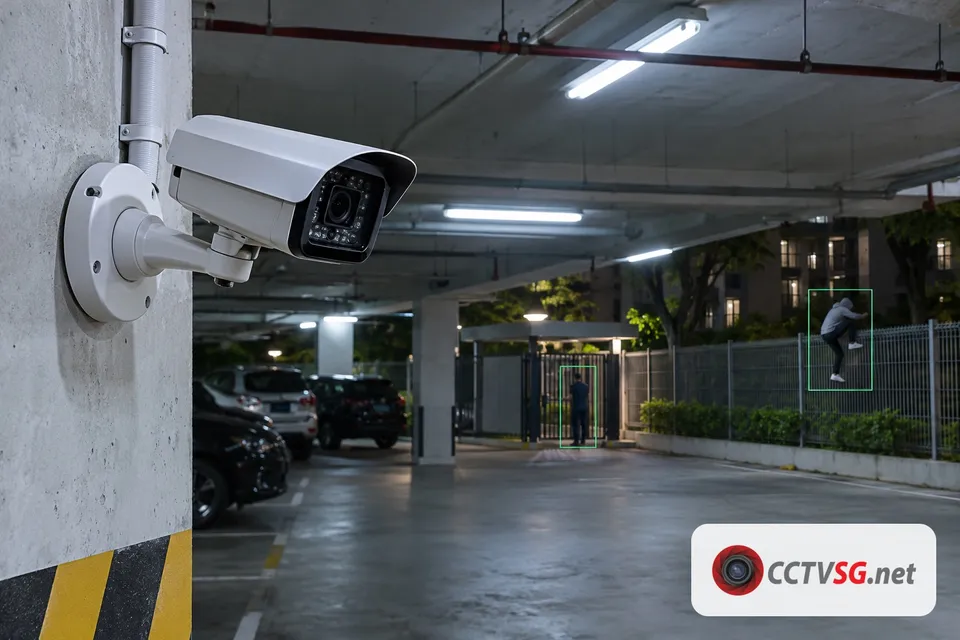
| Climbing Detection | A person climbing over or up a fence, wall, gate or structure | Condo and landed perimeter fences, construction hoarding, warehouse yards, rooftop access | Climbing walls, playground frames |
| Quick Moving | A person moving much faster than normal for the scene | Corridors, cash office approaches, back-of-house exits | Open car parks, running tracks, gyms |
These rules differ from crossing a line. A virtual tripwire fires the moment someone crosses it; long stay fires only after time passes. For tripwires and intrusion zones, see our perimeter intrusion detection guide.
How long should someone stay before a loitering alert?
There is no correct number for every site, and a vendor default is a guess about someone else’s premises. Use your own footage instead:
- Watch a normal week. For each zone, note how long ordinary visitors stay: a delivery rider at a back door, a resident waiting for a lift, a worker at the bin centre.
- Set the limit above the longest normal stay. If deliveries take up to five minutes at the back door, a limit of two minutes will fire all day.
- Use schedules. A lift lobby can have no rule in the day and a short limit after midnight.
- Shrink the zone. Draw only the spot that matters, such as the area in front of a door, so people passing through are not counted.
- Review after two weeks. Count alerts, real cases and misses, then adjust.
Example: suppose a condo’s basement car park has had items taken from cars at night. A useful setup is a long stay zone between the lift lobby door and the far bays, active from 11pm to 6am, with a limit set above the time residents normally take to walk to their cars and load them. Add a camera with a view good enough to recognise a face, so a real alert also produces useful footage.
Is fight detection worth it?
Only if someone can respond. A fight alert is valuable for the first minute: a guard who arrives quickly can separate people, call for help and look after anyone injured. Regulation 7A of the Private Security Industry (Conduct) Regulations 2009 requires a licensed security officer to respond promptly to a request for help from a person in the premises who has been injured or has suffered damage or loss of property. A fight alert helps a guard notice before anyone asks.
If nobody can reach the spot within a few minutes, the clip still helps the police and your own records, but a standard camera with good recording may do that job. Expect look-alikes too: friends play-fighting, a hug, or a crowd at closing time. A person should always check the clip before calling it a fight.
How good does the picture need to be?
The AI may detect behaviour at a distance where a person cannot be recognised in the recording. The SPF Video Surveillance System Standard for Buildings gives a scale for each level of view: 40 mm per pixel to detect a person, 16 mm to observe, 8 mm to recognise and 4 mm to identify. Plan every behaviour zone with at least one camera that reaches the recognise level at the spot where the event happens, so an alert comes with footage you can act on.
A quick check: divide the width of the scene in millimetres by the camera’s horizontal pixel count. A 2560-pixel camera covering a 10-metre-wide car park aisle gives about 3.9 mm per pixel at that distance, which is enough to identify. Covering a 30-metre fence line with the same camera gives about 11.7 mm per pixel, which is enough to observe but not to recognise.
Where do climbing and quick moving detection help?
- Landed homes and condos: climbing over the side gate or the back fence, where a basic motion alert would also fire on cats and swaying plants. Our condo CCTV rules article covers MCST approval for common areas.
- Construction sites: people climbing hoarding at night, and workers climbing scaffolding outside working hours. See the construction site VSS guide.
- Warehouses: climbing over the yard fence or onto loading bay shutters. Our fall detection article covers the related safety rule, which is in the same Behaviour group.
- Retail and cash offices: quick moving towards an exit can point to a snatch-and-run. Pair it with a camera at the door that captures faces.
PDPA, signs and fairness
Behaviour alerts work on identifiable people, so the usual CCTV rules apply: CCTV notices at the entrances (paragraphs 4.37 and 4.41 of PDPC’s Advisory Guidelines on the PDPA for Selected Topics), limited access to clips, and a retention period. Do not aim cameras into homes or other private spaces, and do not share clips in chat groups. Treat a long stay alert as a reason to check, not as proof that someone did something wrong. This is general information, not legal advice.
Which CCTVSG.NET package has these rules?
Fight Detection, Quick Moving, Climbing Detection and Long Stay Detection are in the Behaviour group of AI Pro, together with Fall Detection. AI Pro starts from S$2,400 and also includes the Workplace group, covered in our guide to sleep on duty and absence detection, plus Smart Search by clothing colour, accessories, behaviour and vehicle type. AI Ultra adds People & spaces and Site safety features, pairs a Hikvision or Uniview NVR with an NVIDIA AI processing box, and is quoted per project. AI Lite and AI+ do not include the behaviour rules. See all features on the AI CCTV page. Every package comes with a 1-year onsite warranty.
Get a quote for behaviour detection
Tell us where the problem happens and at what time, and send a photo of each spot. We will suggest which rule fits each spot and where the camera should go. CCTVSG.NET has installed CCTV in Singapore since 2011. Request a quote or WhatsApp us.
Sources
- Private Security Industry (Conduct) Regulations 2009, regulation 7A (Singapore Statutes Online)
- SPF, Video Surveillance System Standard for Buildings (version 2.0, March 2022)
- PDPC, Advisory Guidelines on the PDPA for Selected Topics (revised May 2024)
Each is linked in the sections above.
Frequently asked questions
- What does loitering mean?
- Loitering means staying in one place for a long time without an obvious reason. In CCTV, loitering or Long Stay Detection raises an alert when a person stays in a drawn zone longer than the time you set.
- How does a loitering detection camera work?
- The AI tracks each person in a zone you draw and counts how long they stay. When the time passes your limit, it raises an alert for a guard or manager to check the footage.
- Can CCTV detect a fight?
- Yes, with AI Fight Detection, which looks for violent contact such as hitting or pushing. Play-fighting and crowds can look similar, so a person should check the clip before acting.
- What is climbing detection in CCTV?
- Climbing Detection flags a person climbing a fence, wall, gate or structure in the camera view. It suits perimeter fences, construction hoarding and warehouse yards.
- Which CCTVSG.NET package has loitering and fight detection?
- AI Pro, which starts from S$2,400, and AI Ultra, which is quoted per project. Both include Fight, Quick Moving, Climbing and Long Stay Detection. AI Lite and AI+ do not.
Want this done for you?
We supply and install CCTV, door access, video intercom and Wi-Fi systems across Singapore, from Hikvision, Uniview, Vstarcam, TP-Link, Ruijie and EZVIZ. Send a photo or floor plan and we will recommend a setup and a fixed price.