In short
How AI CCTV flags a guard asleep, an empty post or phone use at work, what Singapore's security officer rules say, PDPA duties to staff, and where it fits.
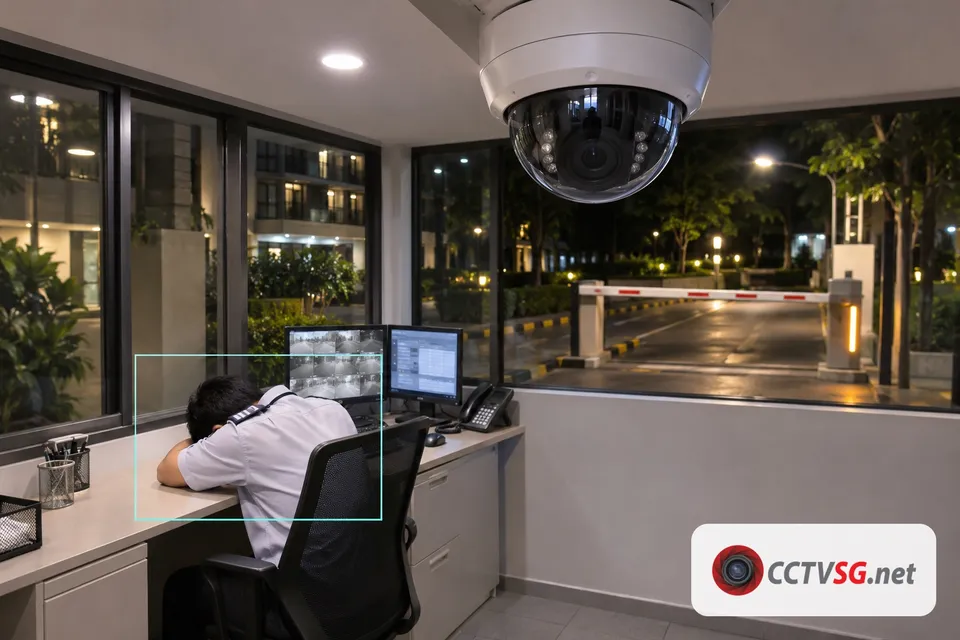
Sleep on duty detection is an AI CCTV rule that flags a person who stays slumped or still at a post, such as a guardhouse desk or a control room console, so a supervisor can check at once instead of finding out the next morning. The same Workplace group also covers an empty post (Absence Detection), a phone held to the ear (Calling Detection) and a person looking at a phone (Using Mobile Detection). At CCTVSG.NET these four rules are part of AI Pro, which starts from S$2,400, and AI Ultra.
Key Takeaways
- In Singapore, sleeping on duty and leaving the post without a valid reason are offences for licensed security officers under regulation 7A of the Private Security Industry (Conduct) Regulations; under regulation 8(2) the penalty is a fine of up to $2,000, jail of up to 3 months, or both.
- The camera tells you when to look. A supervisor should always check the clip before anyone is spoken to.
- Draw the zone around the seat or post, and set the absence time to match the post orders, not the camera’s default.
- Tell staff in writing where the cameras are and why. Never put a camera in a toilet or a rest room.
- Use it where an unattended post costs something real: a guardhouse, a control room, a cash counter or a lab, not to time every desk in an office.
What do the four Workplace detection rules do?
Each rule answers one question about a person at a work position. Systems of this type find the person, then look at posture, head position, hands and time spent in a zone you draw on the image.
| Rule (as named on our AI CCTV page) | Question it answers | Good place | Poor place |
|---|---|---|---|
| Sleep on Duty Detection | Is the person at the post slumped or not moving? | Guardhouse, lobby counter, control room, night shift at a plant | Rest area, pantry, any place where resting is allowed |
| Absence Detection | Is the post empty for longer than allowed? | Guard post, gate, cashier, reception, lab station | Hot desks, meeting rooms, roles that patrol |
| Calling Detection (during work) | Is someone on a phone call at the work position? | Machine areas, packing lines, cash counters with a no-phone rule | Sales and service desks where calls are the job |
| Using Mobile Detection | Is someone looking at a phone instead of the task? | Control rooms, CCTV consoles, production lines with a phone policy | Offices where phones are a work tool |
AI Pro also has a Smart Search option for the behaviour “Calling”, so you can search recorded footage for people on a phone call rather than scrolling through hours of video.
What do Singapore’s rules say about guards sleeping on duty?
They are written into law. Regulation 7A(1) of the Private Security Industry (Conduct) Regulations 2009 says that a licensed security officer on duty must not sleep, must not be absent from the place of deployment without any valid reason, and must respond promptly to a request for help from a person in the premises who has been injured or has suffered damage or loss of property. Under regulation 8(2), breaking regulation 7A can bring a fine of up to $2,000, jail of up to 3 months, or both. These rules took effect on 1 January 2019.
So for a condo MCST, a building owner or a security agency, the camera is a check on duties that already exist. It does three useful things:
- It catches the problem during the shift, when it can still be fixed, instead of after an incident.
- It gives the agency supervisor a time-stamped clip to act on, which is fairer than a resident’s complaint the next day.
- The clip lets the supervisor check whether the guard left for a valid reason, such as helping an injured resident, which the rules require.
The guard is employed by the security agency, not by the MCST. Agree with the agency, in the contract, who receives the alerts and what happens next. If you are moving to outcome-based security contracts, see the SPF page on outcome-based security contracting. Our article on security patrol robots covers another option.
How do you set it up so it is fair and useful?
Many avoidable false alerts come from the settings, not from the AI. Work through these five decisions before the cameras go up:
- Which post. List the posts where an unattended or sleeping person costs something: a gate that must open for an ambulance, a console that must see an alarm, cash, chemicals.
- Which zone. Draw the zone around the seat and the desk only. If the zone includes the walkway, every passer-by counts as “present” and the absence rule never fires.
- How long. Take the allowed time away from the post from the post orders (a toilet break, a patrol round) and set the absence time just above it. Do the same for a short rest with eyes closed if your policy allows it during a break.
- Who sees the alert. Name one person per shift, usually the agency supervisor or the duty manager, and a backup. An alert nobody owns is noise.
- What happens next. Write it down: call the post, check the clip, then decide. Do not let the alert itself be the discipline.
Camera position matters as much as the settings. Mount the camera in front of the person and slightly above, so the head and hands are visible. A camera behind the chair sees a back, and a strong window behind the desk turns the person into a silhouette at midday.
Worked examples: which rule for which Singapore site?
| Site | Rule | Why | Mistake to avoid |
|---|---|---|---|
| Condo guardhouse, night shift | Sleep on Duty + Absence | Visitors and contractors pass the barrier unchecked when the post is empty or asleep | Zone that includes the barrier lane, so cars count as presence |
| Commercial building fire command or CCTV room | Using Mobile + Sleep on Duty | The operator has to see the screens and the alarm panel | Camera aimed at the screens, which records private chat on phones but not the operator’s face |
| Warehouse packing line | Calling Detection | Only where your own safety rules ban phones near moving machines | Alerts in the canteen corner of the same view |
| Retail cash counter | Absence Detection | Cash drawer and goods left with nobody at the counter | Absence time shorter than a normal stock run |
| Small office reception | Usually none | Phones and short absences are part of the job | Buying AI to fix a rota problem |
PDPA and staff: what must employers do?
Footage of identifiable staff is personal data. In a parliamentary reply on CCTVs at workplaces (18 September 2023), MOM said organisations using surveillance cameras must meet their PDPA obligations. It added that they should set clear rules on how and where devices are used, should place them only where there are safety and security concerns and not in private areas such as restrooms, and should tell workers the purpose, for example in the employee handbook. PDPC’s Advisory Guidelines on the PDPA for Selected Topics cover CCTV notices (paragraphs 4.37 and 4.41) and informing employees of the purpose (paragraph 4.39).
In practice: put the purpose in the post orders or staff handbook, put up CCTV notices, keep the camera off rest areas, limit who can view clips, and set a retention period. For guards, the agency should brief its officers too. This is general information, not legal advice.
What can go wrong, and how do you check it works?
Expect some false alerts at first. A guard reading a logbook with the head down can look like sleeping, a person rubbing an ear can look like a call, and a cleaner passing through can make an empty post look occupied. We do not publish an accuracy rate, because it changes with angle, distance and light at each post.
Run a two-week check instead. For each post, count three numbers: alerts raised, alerts that were real, and real events that were missed (from the supervisor’s own rounds). If false alerts are high, move the camera or tighten the zone. If misses are high, lower the time threshold or improve the lighting.
Which CCTVSG.NET package has these rules?
Sleep on Duty, Absence, Calling and Using Mobile Detection are in the Workplace group of AI Pro, which starts from S$2,400 and is built on Uniview with advanced AI detection and Smart Search. AI Pro also includes the Behaviour group (fight, climbing, long stay and quick moving), covered in our guide to loitering, fight and climbing detection. AI Ultra includes the same rules and adds site safety features; it pairs a Hikvision or Uniview NVR with an NVIDIA AI processing box and is quoted per project. AI Lite and AI+ do not include the Workplace rules. See every feature on the AI CCTV page, and read how to implement AI CCTV before you buy. Every package comes with a 1-year onsite warranty.
Get a quote for guard post and workplace detection
Send us a photo of each post taken from where a camera could go, plus the post orders or shift pattern. We will tell you which rules fit, where to mount the camera, and whether a normal camera is enough. CCTVSG.NET has installed CCTV in Singapore since 2011. Request a quote or WhatsApp us.
Sources
- Private Security Industry (Conduct) Regulations 2009, regulations 7A and 8 (Singapore Statutes Online)
- MOM, oral answer to PQ on guidelines for CCTVs at workplaces (18 September 2023)
- PDPC, Advisory Guidelines on the PDPA for Selected Topics (revised May 2024)
- SPF, Security Outcome-Based Contracting
Each is linked in the sections above.
Frequently asked questions
- Can CCTV detect a security guard sleeping on duty?
- Yes. AI Sleep on Duty Detection flags a person who stays slumped or still in a zone drawn around the post. A supervisor should check the clip before acting, because reading with the head down can look similar.
- Is sleeping on duty an offence for security officers in Singapore?
- Yes. Regulation 7A of the Private Security Industry (Conduct) Regulations 2009 says a licensed security officer on duty must not sleep or be absent from the post without a valid reason. The penalty is a fine of up to $2,000, jail of up to 3 months, or both.
- Do I have to tell employees about AI CCTV at work?
- Yes. MOM says employers must meet their PDPA obligations and should tell workers the purpose of workplace cameras, for example in the employee handbook. Put up CCTV notices and never place cameras in restrooms.
- What is absence detection in CCTV?
- Absence Detection raises an alert when nobody is in a drawn zone, such as a guard post or cashier counter, for longer than the time you set. Set the time from your post orders, above the normal break.
- Which CCTVSG.NET package has sleep on duty detection?
- AI Pro, which starts from S$2,400, and AI Ultra, which is quoted per project. Both include Sleep on Duty, Absence, Calling and Using Mobile Detection. AI Lite and AI+ do not.
Want this done for you?
We supply and install CCTV, door access, video intercom and Wi-Fi systems across Singapore, from Hikvision, Uniview, Vstarcam, TP-Link, Ruijie and EZVIZ. Send a photo or floor plan and we will recommend a setup and a fixed price.