
In short
How AI CCTV spots cars in no-parking zones and blocked escape routes, who to report illegal parking to in Singapore, and what the Fire Safety Act requires.
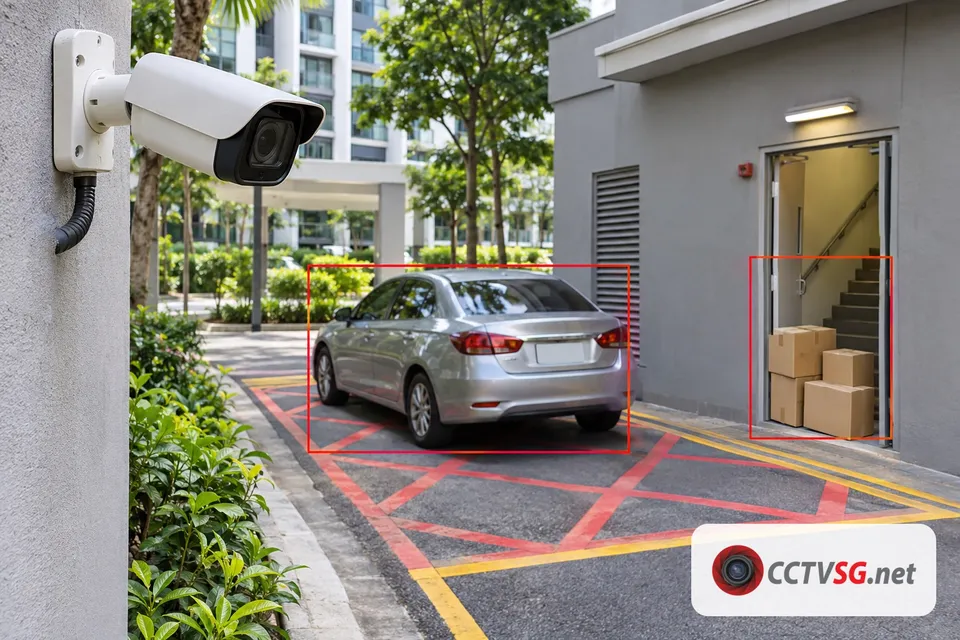
Illegal parking detection is an AI CCTV rule that flags a vehicle that stops in a no-parking zone, such as a fire engine access road, a drop-off porch or a loading bay, for longer than the time you allow. Evacuation Route Obstruction Detection does the same for escape routes: it flags objects left in a corridor, at an exit door or on a staircase landing. Both help a condo MCST, building owner or facility team clear the problem before an inspection, a complaint or a fire. At CCTVSG.NET both are part of AI Ultra, which is quoted per project.
Key Takeaways
- Inside a condo or private car park, the owner or MCST manages parking. For HDB car parks, report on the OneService app or HDB’s Parking Enforcement Hotline 1800-338-6622; for public roads, use the OneService app.
- SCDF’s Fire Code says fire engine accessways must be kept clear of obstructions at all times and must not be used as car parking lots, including for loading and unloading.
- Under the Fire Safety Act, any person who obstructs an escape route, passageway or common property in a way that makes escape harder commits an offence, and owners and occupiers who know, or ought to know, of such a hazard must take reasonable steps to abate it.
- The camera’s value is time: it flags the car or the trolley minutes after it appears, not at the next walk-round.
- Set the allowed time from your own house rules. The camera measures; your by-laws decide.
Who deals with illegal parking in Singapore?
It depends on where the car is:
| Where | Who acts | How to report |
|---|---|---|
| HDB car parks and service roads | HDB’s parking wardens | OneService app or 1800-338-6622; HDB says the warden is alerted at once |
| Public roads | LTA | OneService app, as LTA said in June 2026; first-time offenders can be fined up to $300 |
| Condo, office or mall car park (private) | The owner or the MCST | The management office, under the house rules or by-laws |
| Dispute about a private car park fine | Owner or MCST first, then the Strata Titles Board for mediation | See MOT’s reply of 13 January 2026 |
MOT’s reply also says that private parking spaces are managed privately by the owner or the MCST, and that LTA issues a Code of Practice so that car parks have clear signs telling motorists about charges, fees and fines. So an MCST that wants to act on illegal parking needs two things in place: clear signs and rules, and a way to know when a car is parked where it should not be. The camera covers the second part.
What does the law say about fire engine access and escape routes?
Two sets of rules matter for parking and blocked exits.
Fire engine accessways. Clause 4.2.2 of the SCDF Fire Code says fire engine accessways and access roads shall be kept clear of obstructions at all times, and shall not be turned into other uses such as car parking lots, including loading and unloading. It also says they should be marked with signs to prevent unauthorised parking.
Escape routes. Section 27 of the Fire Safety Act 1993 makes it an offence for any person to cause an escape route, passageway, common property or limited common property to be obstructed in a way that might make escape in a fire more difficult and that cannot easily be removed by someone escaping. Section 26 makes it an offence for an owner or occupier who knows, or ought to know, of such a hazard not to take reasonable steps to abate it. Where the Act sets no specific penalty, the general penalty in section 107 is a fine of up to $10,000, jail of up to 6 months, or both, with up to $1,000 more for every day a continuing offence goes on after conviction. MHA has said that SCDF takes an escalating approach, with higher fines for repeated breaches and prosecution for serious ones.
Section 26 covers owners and occupiers who know or ought to know of a hazard. Alerts can help you find obstructions sooner; act on each one and keep a record.
Which zones should the camera watch?
| Zone | Rule | Allowed time (set by you) | Watch out for |
|---|---|---|---|
| Fire engine access road in a condo or factory | Illegal Parking | Shortest of all; the Fire Code does not allow parking or loading there | Residents waiting for ride-hail pick-ups; agree who checks the alerts |
| Drop-off porch | Illegal Parking | Above a normal drop-off, from a week of footage | Taxis queueing at peak times |
| Loading bay | Illegal Parking | Above the booked loading slot | Contractor vans parked all day |
| Corridor to an exit staircase | Evacuation Route Obstruction | Short, outside cleaning and delivery times | Cleaning trolleys, renovation materials |
| Exit door and the floor in front of it | Evacuation Route Obstruction | Short | Pallets, bins, bicycles |
| Staircase landing | Evacuation Route Obstruction | Short | Shoe racks, storage boxes, plants |
Two placement rules make the difference. First, mount the camera so the floor in front of the exit door stays visible even when something is placed there; a camera at door height is blinded by the first stack of boxes. Second, keep the zone tight. A zone covering the whole driveway will fire on every car that slows down.
What happens after an alert?
- Check. The guard or manager looks at the clip. A delivery van that leaves in two minutes needs no action.
- Act. Ask the driver to move, or remove or report the obstruction. Note the time.
- Find repeat cases. AI Ultra includes Car Plate Comparison and Smart Search by vehicle type, brand and colour, so you can find the same vehicle on other days without scrolling through hours of video. See our car plate recognition guide.
- Fix the cause. If the same porch is blocked every evening, the answer may be a marked pick-up bay or a change to the house rules, not more alerts.
Keep the use of footage within your rules. Car plates and identifiable people are personal data, so put up CCTV notices and limit who can see clips, as PDPC’s advisory guidelines explain. For condos, our condo CCTV rules article covers approvals for cameras in common areas. This is general information, not legal advice.
What can it not do?
- It does not replace fire safety checks. The Fire Safety Manager’s rounds, fire alarms and exit signs stay the same. For smoke and flames, see our smoke and fire detection guide.
- It does not issue fines. Private car park charges depend on your signs and rules under LTA’s Code of Practice; public road and HDB enforcement is done by the agencies.
- It does not check whether fire doors close properly or whether exit doors are locked. Those still need the usual human checks.
- Results change with angle, light and distance, so we do not publish an accuracy rate. Run a two-week check: count alerts, real cases and missed cases, then adjust the zones and times.
Which CCTVSG.NET package has these features?
Illegal Parking Detection and Evacuation Route Obstruction Detection are in the Site safety group of AI Ultra, together with Smoking Detection and Smoke and Fire Detection. AI Ultra pairs a Hikvision or Uniview NVR with an NVIDIA AI processing box and is designed around the project, so it is quoted per site. AI Lite, AI+ and AI Pro do not include these two rules, although AI Pro (from S$2,400) has Car Plate Comparison and behaviour rules such as loitering and climbing detection. See all features on the AI CCTV page. Every package comes with a 1-year onsite warranty.
Get a quote for parking and exit monitoring
Send us a site plan with the fire engine access road, drop-off points and exit staircases marked, plus photos of the spots that are often blocked. We will tell you which views need AI and which need only a normal camera. CCTVSG.NET has installed CCTV in Singapore since 2011. Request a quote or WhatsApp us.
Sources
- HDB, Report a Parking Offence
- LTA, media reply “Good parking etiquette is essential” (4 June 2026)
- MOT, written reply on parking fine enforcement in private car parks (13 January 2026)
- SCDF, Fire Code 2023, clause 4.2
- Fire Safety Act 1993, sections 26, 27 and 107 (Singapore Statutes Online)
- MHA, reply on repeated Notices of Offence for fire safety breaches (6 March 2025)
- PDPC, Advisory Guidelines on the PDPA for Selected Topics (revised May 2024)
Each is linked in the sections above.
Frequently asked questions
- How do I report illegal parking in Singapore?
- For HDB car parks, service roads and public roads, use the OneService app; for HDB car parks you can also call the Parking Enforcement Hotline at 1800-338-6622. In a condo or other private car park, report it to the management office or MCST.
- Can you park on a fire engine access road?
- No. SCDF's Fire Code says fire engine accessways must be kept clear of obstructions at all times and must not be used as car parking lots, including for loading and unloading.
- Is blocking a fire exit an offence in Singapore?
- Yes. Section 27 of the Fire Safety Act makes it an offence to obstruct an escape route, passageway or common property in a way that makes escape in a fire more difficult. The general penalty is a fine of up to $10,000, jail of up to 6 months, or both.
- How does an illegal parking detection camera work?
- You draw a no-parking zone on the image and set the allowed time. When a vehicle stays in the zone longer than that, the AI raises an alert so a guard or manager can check the footage and act.
- Which CCTVSG.NET package has illegal parking detection?
- AI Ultra, which pairs a Hikvision or Uniview NVR with an NVIDIA AI processing box and is quoted per project. It also includes Evacuation Route Obstruction Detection. AI Lite, AI+ and AI Pro do not.
Want this done for you?
We supply and install CCTV, door access, video intercom and Wi-Fi systems across Singapore, from Hikvision, Uniview, Vstarcam, TP-Link, Ruijie and EZVIZ. Send a photo or floor plan and we will recommend a setup and a fixed price.