In short
How AI kitchen CCTV checks chef hats and masks and spots rats after closing, what SFA requires in 2026, and which checks are worth switching on in your kitchen.
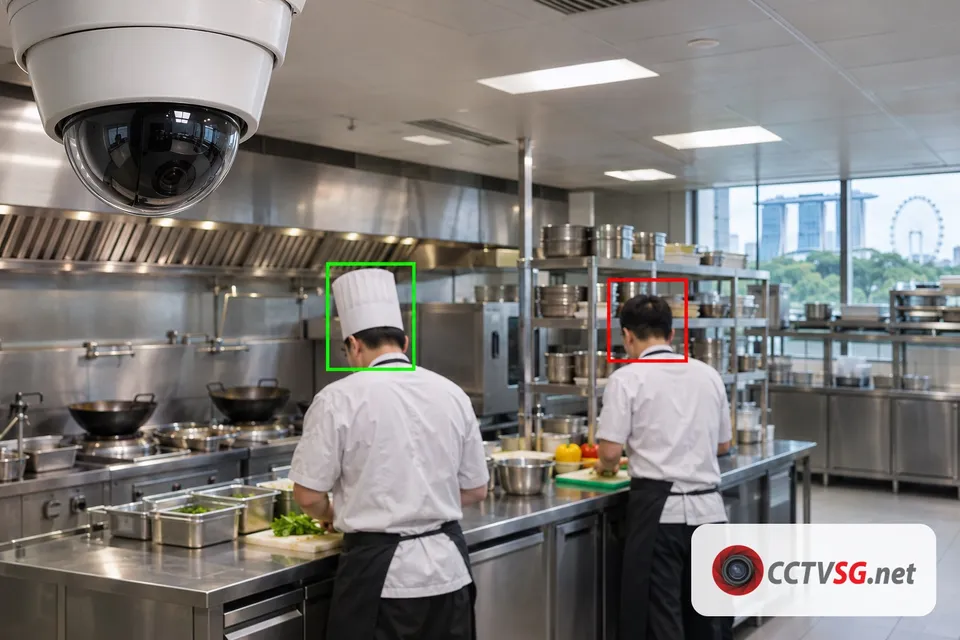
AI kitchen CCTV uses cameras that recognise three things a food business cares about: staff without a chef hat, staff without a mask, and rats. At CCTVSG.NET these are the No Chef Hat, No Mask and Rat Detection features of our AI Pro and AI Ultra packages. Since 1 January 2026, SFA no longer makes masks mandatory for food handlers, so the rat check now watches the issue that carries the most demerit points, while the attire checks support your own house standard.
Key Takeaways
- SFA says masks and spit guards are not mandatory from 1 January 2026, but are highly encouraged for ready-to-eat food, mass catering and large-scale manufacturing.
- Pest infestation is a serious offence worth 6 demerit points. Two in 12 months reach the 12-point line for a licence suspension.
- A suspension under the points system counts as a major lapse, which drops an outlet straight to grade C under SFA’s SAFE framework.
- Set attire checks for service hours and rat checks for closing hours, and name the person who reviews them each morning.
- AI does not replace cleaning, pest control or training. It shows where and when to look.
Are masks and chef hats required by SFA in 2026?
Masks: no. SFA’s page on masks and spit guards for food handlers (updated 27 October 2026) says that with effect from 1 January 2026 it is not mandatory to wear them. It covers retail premises such as restaurants, hawkers, food courts and coffeeshops, and also food factories. Check your own licence conditions too, especially for temporary fair stalls.
Chef hats: SFA’s offence list has no separate chef-hat item, and we have not found a blanket rule for restaurants. Its published list of offences and demerit points (updated 26 May 2025) names “fail to wear clean attire or keep body clean”, at 4 points. Other licence types and many brands set their own head cover rules, so check your licence conditions and franchise manual.
That changes what each check is for. Use this split before you switch anything on:
| AI check | What it protects | What SFA publishes | Worth switching on when |
|---|---|---|---|
| Rat Detection | Early warning of infestation | Infestation: serious offence, 6 points, $400 composition sum | Someone will review it each morning |
| No Mask Detection | Your food safety practice | Not mandatory; highly encouraged for ready-to-eat food, mass catering and large-scale manufacturing | You run a salad, sashimi, cut-fruit, bakery or catering line |
| No Chef Hat Detection | Your house or brand standard | Clean attire is an offence item (4 points); a hat is not named | Your standard requires head covers and supervisors cannot be everywhere |
| Smoking Detection (AI Ultra) | Hygiene and fire safety | “Smoke tobacco” is listed at 4 points | Staff smoke at the back door or in stores |
What do two infestation offences cost? A worked example
SFA suspends a licence when 12 demerit points build up within 12 months (Points Demerit System). A rat on camera is not itself an offence; points follow SFA’s enforcement. For a restaurant or food stall, the arithmetic is:
| What happens in 12 months | Points | Result |
|---|---|---|
| One infestation offence | 6 | $400 composition sum, no suspension yet |
| One infestation + one dirty-premises offence | 6 + 4 = 10 | $400 + $300 = $700, and 2 points from suspension |
| Two infestation offences | 6 + 6 = 12 | $800, and a first suspension of 2 weeks |
A suspension under the points system is a major lapse, so the outlet drops straight to grade C under the SAFE framework.
To weigh the cost for your own outlet, multiply your average daily takings by 14 days, then add rent and staff pay that continue while you are closed. An outlet that takes $2,500 a day, for illustration, forgoes $35,000 of sales in a 2-week suspension, plus the $800, before counting a grade C on the wall. Another 12 points within 12 months after the first suspension brings 4 weeks, and 12 more after the second means the licence is revoked. Operators of food courts, coffeeshops and canteens face shorter suspensions, starting at 1 day (SFA’s table).
How does AI chef hat, mask and rat detection work?
- You draw the area on the camera image, such as the prep counter or the floor by the bin store.
- In service hours, the AI finds each person and checks the head for a hat or the face for a mask.
- In closing hours, it looks for a rat moving in the view.
- When something matches, it records the event so a manager can check it and act.
The camera can only judge what it sees. Steam, grease on the lens, people facing away and clutter in front of the wall all reduce detection. A rat that stays inside a wall, a false ceiling or behind a chiller will not be seen, which is why a camera supports pest control and does not replace it.
Where should cameras go in a restaurant kitchen?
Place cameras where the two jobs, people and pests, really happen. SFA’s pest guidelines and good-practice sheet name the weak points: gaps in ceilings and walls, uncovered floor traps and gullies, refuse areas, food left out overnight, and food remnants under cooking ranges. As an example plan, a 40-seat restaurant with a rear exit could use five views:
| View | Service hours | Closing hours | Placement tip |
|---|---|---|---|
| Prep and cold counter | No Chef Hat, No Mask | Off | Face the staff at an angle, away from the steam of the woks |
| Floor under the range and sinks | Off | Rat | A separate low view; the counter camera sits too high for floor level |
| Dry store | Off | Rat | Low view along the shelf base; keep food off the floor so the gap stays visible |
| Bin area and back door | Off | Rat, Intrusion | Light it; cover the gully and the gap under the door |
| Cashier and dining entrance | Normal recording | Intrusion | Keep this one for security, not hygiene |
Why the separate floor view? A rat is small on screen. As an illustration, a 150 mm body in a scene scaled at 8 mm per pixel is only about 19 pixels long, so a wide view of the whole kitchen is the wrong tool. Use tight views and keep a low light on at night. This is arithmetic, not a product detection range.
Keep the hot line out of any smoke and flame detection zone, as our guide to smoke and fire detection cameras explains. Never place cameras in changing rooms or toilets.
A closing checklist that makes rat detection useful
A rat event at 2 am is only useful if the morning team can tell why it came. These checks come from SFA’s prevention guidelines and good practices for retail food establishments:
- Clean the kitchen at the end of the day, including under the cooking range and sinks.
- Empty bins at least once a day; keep them lined and covered.
- Clean drains and gullies daily and check the trap covers are in place.
- Store food off the floor and in covered containers. SFA’s 2019 guideline says at least 15 cm; its newer good-practice sheet shows at least 30 cm. Use 30 cm and you meet both.
- Leave nothing hanging or soaking overnight.
- Seal holes in ceilings and walls; check wire mesh at doors and windows.
- Inspect traps daily, and have pest control treatment monthly.
Then run each event through the same four steps: check the clip, mark the spot on a floor plan, find the food source or entry point, and send the clip to your NEA-licensed pest control company. Three clips at one spot point to a gap. Three clips at three spots point to a wider problem. Keep the log: it helps you verify your contractor’s work, which SFA says is the licensee’s responsibility.
What should you tell kitchen staff?
Footage of identifiable staff is personal data. The PDPC’s guidelines (paragraph 4.39) say an employer may rely on the employment exception where the purpose is managing the employment relationship and staff are told that purpose, for example in the handbook. Pest control and security views also catch contractors and visitors, so put up notices as well (paragraphs 4.37 and 4.41). We suggest using attire events for coaching on the shift. Sound recording needs separate care; see CCTV audio recording and the law. This is general information, not legal advice.
When is AI kitchen CCTV not worth it?
- A single small stall with the owner always present. You already see every hat. A basic camera on the closing-hours floor may be enough. See why restaurants install CCTV.
- A kitchen that has not fixed the basics. Spend on sealing gaps and pest control first. The camera will only confirm what you know.
- No one to act. If no manager will check events each morning, choose recording only.
It fits best for multi-outlet groups, central kitchens, caterers, hotels and food courts, where one manager is responsible for several kitchens.
Which CCTVSG.NET package has kitchen AI?
| Package | Kitchen features | Starting price |
|---|---|---|
| AI Lite and AI+ | No chef hat, mask or rat detection | From S$250 and S$980 |
| AI Pro (Uniview) | No Chef Hat, No Mask and Rat Detection, plus Intrusion and Smart Search | From S$2,400 |
| AI Ultra (NVIDIA AI box) | All of AI Pro plus Smoking, Smoke and Fire, and blocked evacuation route detection | Quote per site |
Every package comes with a 1-year onsite warranty. See the full feature list on the AI CCTV page.
Get a kitchen CCTV quote
Send us your kitchen layout, your opening hours and the checks you want. We will suggest the camera views and package, and tell you if a simpler system is enough. CCTVSG.NET has installed CCTV in Singapore since 2011. Request a quote or WhatsApp us.
Sources
- SFA, Wearing of Masks or Spit Guards by Food Handlers (updated 27 October 2026)
- SFA, List of Offences and Corresponding Demerit Points (updated 26 May 2025)
- SFA, Understanding the Points Demerit System (updated 27 October 2026)
- SFA, Understanding the SAFE Framework (updated 11 November 2026)
- SFA, Guidelines on Prevention of Rat and Cockroach Infestations (31 May 2019) and Good Practices in Managing / Preventing Rat Activity
- PDPC, Advisory Guidelines on the PDPA for Selected Topics (revised May 2024)
All are linked in the sections above.
Frequently asked questions
- Must food handlers in Singapore wear masks in 2026?
- No. SFA says that from 1 January 2026 it is not mandatory for food handlers to wear masks or spit guards. They are highly encouraged when handling ready-to-eat food, in mass catering and in large-scale manufacturing.
- Can CCTV detect rats in a kitchen?
- Yes, with an AI camera that has Rat Detection. It flags a rat moving in its view and records the event. It cannot see rats inside walls, ceilings or behind equipment, so use it with pest control.
- How many demerit points is a pest infestation?
- SFA lists failing to keep licensed premises free of infestation at 6 points and a $400 composition sum. A licence is suspended at 12 points within 12 months.
- Does an AI camera replace pest control?
- No. It shows where and when a rat appeared. Cleaning, sealing gaps and an NEA-licensed pest control company still do the work.
- Do I need to tell kitchen staff about the cameras?
- Yes, to rely on the PDPA’s employment exception you must inform staff of the purpose, for example in the employee handbook. Do not place cameras in changing rooms or toilets.
- Which CCTVSG.NET package detects chef hats, masks and rats?
- AI Pro (Uniview) and AI Ultra (Hikvision or Uniview NVR with an NVIDIA AI processing box) include No Chef Hat, No Mask and Rat Detection. AI Ultra is quoted per site.
Want this done for you?
We supply and install CCTV, door access, video intercom and Wi-Fi systems across Singapore, from Hikvision, Uniview, Vstarcam, TP-Link, Ruijie and EZVIZ. Send a photo or floor plan and we will recommend a setup and a fixed price.